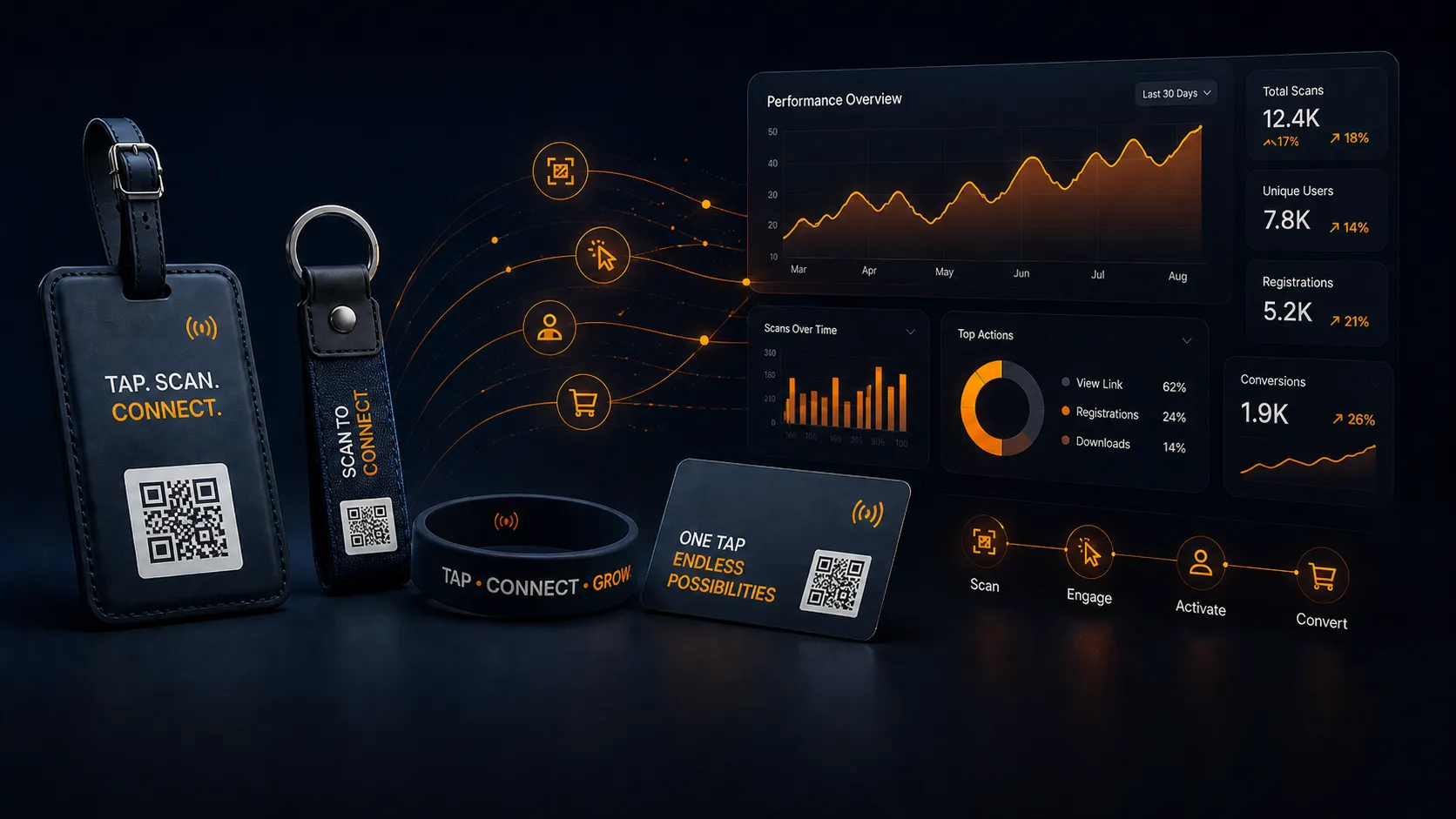
Promotional items have been a staple of everyday marketing for decades. Pens, key fobs, luggage tags or shopping cart tokens are distributed, remain visible in daily life and create recurring brand touchpoints. Their strength lies in not disappearing after a few seconds – but staying present as a physical object for months or even years. Or do they?
The Black Hole in Promotional Marketing
For many companies, measurability ends at the point of distribution. They know how many items were produced, what they cost and at which event they were handed out. What happens after that usually remains unclear.
Were the items actually used – or do they end up in a drawer?
How often did the brand actually re-enter the recipient's daily life?
Did anyone visit the website, install an app or make an inquiry afterwards?
Which promotional item worked better?
Which target group or campaign generated the highest response?
While digital campaigns are long evaluated on click-through rates, conversion rates and attribution, classic promotional items often operate in the realm of assumptions and rule-of-thumb estimates. That's no longer good enough.
BrandTags – Digital Function Creates Digital, Measurable Interaction.
The key insight behind BrandTags is not a QR code as an ad link. It's a real everyday benefit that motivates recipients to scan the code voluntarily – because they get something out of it themselves.
Luggage Tag
Loss protection – helps recover lost luggage
Key Tag
Anonymous reachability – finders can get in touch
SOS Wristband
Emergency ID – provides key contacts when it matters most
RFID Blocker
Payment protection – shields contactlessly readable cards
Not "Here is our logo – please remember us."
But: "Here is a useful companion that helps you every day – and our brand stays meaningfully present."
Because the benefit is real, genuine voluntary interaction occurs. And that interaction can be measured for the very first time.
Which Metrics Become Visible for the First Time
With BrandTags, companies can stop hoping that a promotional item gets used. They can see it.
Activation Rate
How many distributed items were actually registered?
Scans & Usage
How often are codes scanned? Is there recurring usage?
Campaign Links
Clicks on landing pages, app downloads, newsletters or product pages.
A/B Comparison
Which product variant, which trade fair or which target group generates more response?
From Gut Feeling to Optimization
Once promotional items become measurable, the decision-making logic changes fundamentally.
Before
- — "Which gift do we like?"
- — Experience values & estimates
- — Budget decisions based on gut feeling
- — Unknown wastage
Today
- → "What gets activated and used?"
- → Campaign data & metrics
- → Budget optimization by conversion
- → Data-driven iteration
A company can test whether a luggage tag outperforms a key fob. It can see whether trade fair contacts respond differently than existing customers. It can adjust campaign links seasonally and set UTM parameters to attribute conversions directly in analytics systems. A promotional item becomes a performance channel – without losing its physical advantage.
BrandTags – Promotional Items with Measurable Impact
Activations, scans, campaign links – see for the first time what your promotional item actually delivers.
Conclusion
Promotional items have long been a powerful but hard-to-measure tool. The industry could prove that items get used, kept and remembered – but individual companies often couldn't say what their specific campaign had actually achieved.
The promotional gift becomes a product with real function.
The logo item becomes a digital touchpoint.
Wastage becomes a usage data foundation.
Gut feeling becomes optimization.
This is the new era of promotional items: away from hoping, towards measurable impact.